


US Builds Largest Consulate in the World in Lagos While Visa Ban Keeps Nigerians Out
 West Africa WeeklyOctober 12, 20263 Mins read13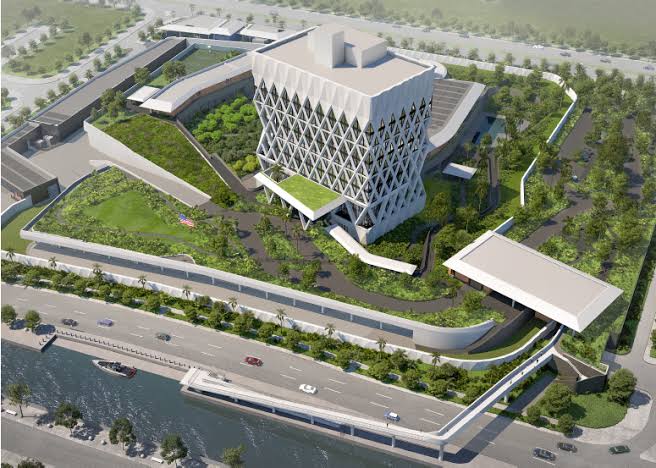
The United States is constructing its largest consulate in the world in Lagos, a $537 million, 10-storey facility on 12.2 acres in Eko Atlantic City, scheduled for completion in 2028. At the same time, the US has partially suspended visa issuance to Nigerian nationals under Presidential Proclamation 10998, which took effect on January 1, 2026, covering B-1/B-2 visitor visas, F, M and J student and exchange visitor visas, and all immigrant visas with limited exceptions.
The contradiction has raised questions among Nigerians about the purpose of the massive facility. The US Mission says the new consulate is “a tangible expression of the longstanding bilateral partnership that has defined our journey together for over 65 years” and will provide modern space for health cooperation, cultural exchanges, security cooperation and commercial partnership. The project is estimated to inject $95 million into the Nigerian economy and employ approximately 2,500 Nigerians.
But the visa ban complicates the picture. Under Proclamation 10998, Nigerians applying for B-1/B-2, F, M, J and immigrant visas may still submit applications and schedule interviews, but they may be ineligible for visa issuance. The consulate will process applications that the US government has already decided most Nigerians cannot receive.
The US has also centralised visa processing across Africa, designating Lagos as one of 20 regional hubs. Routine visa services at the US Embassy in Abuja ended on August 1, 2026. Twenty-five other US posts across Africa have been downgraded to limited services. Applicants from Nigeria and other countries must now travel to Lagos, Abidjan, Accra, Addis Ababa, Cape Town, Dakar, Nairobi, Johannesburg or Kinshasa to process their visas. Lagos is not just a hub for Nigeria. It is the hub for the region.
Declassified JFK-era files released in 2025 list Lagos as one of several African cities where the CIA established covert bases starting in the 1960s, alongside Johannesburg, Nairobi, Pretoria, Rabat and Salisbury. British researcher Susan Williams documented in her 2021 book White Malice how the CIA aimed to integrate newly independent African nations into the capitalist sphere while thwarting alignment with socialist ideologies. The agency’s operations in Africa included the assassination of Patrice Lumumba and the ousting of Kwame Nkrumah. Lagos ranked second among five African cities reportedly hosting secret CIA spy bases in the declassified documents.
A leaked document circulated on Nairaland in March 2025 claimed the CIA has field offices in six major cities across five nations, including Lagos, and noted that Abuja, the capital, did not have an office while Lagos did. The document also referenced allegations that President Bola Tinubu was a CIA agent and described him as a landlord to the agency in Lagos. The US government has never confirmed or denied the presence of a CIA station in Lagos.
The CIA question does not exist in isolation. The US Africa Command has been expanding its footprint in Nigeria throughout 2026. In February, AFRICOM chief General Dagvin Anderson visited Abuja and met President Tinubu and Defence Minister Christopher Musa. The US deployed about 200 troops and MQ-9 drones to Nigeria to provide training and intelligence support while Nigerian forces conducted operations against Islamist militants. In August, AFRICOM disclosed that it had trained Nigerian forces in drone warfare, combat medicine and explosive disposal at an operating location in Bauchi State. AFRICOM later withdrew most of the troops deployed for a specific counterterrorism operation but maintained intelligence-sharing and security cooperation.
The visa restrictions are not limited to Proclamation 10998. In August 2026, the US imposed a $20,000 visa bond on Nigerian applicants, a move that Nigerian diplomatic experts described as discriminatory and ridiculous and called for retaliatory measures. The US also issued a Do Not Travel advisory for Nigeria and suspended visa operations at its Abuja embassy in April 2026, citing security concerns. The Nigerian government criticised the advisory as unbalanced and warned it could erode confidence in the country.
The travel restrictions have already reduced passenger traffic on Nigeria-US routes. Airlines operating international routes out of Nigeria have recorded a gradual drop in passengers travelling to North America. Industry observers say travel between Nigeria and the US had already slowed due to the difficulties of securing a visa.
The new consulate will not make it easier for Nigerians to get visas. In fact, the centralisation of visa processing in Lagos, combined with the visa ban, means that Nigerians who are eligible for the few visa categories still available will have to travel to Lagos to apply. Residents of other states must bear the cost of travel, accommodation and time away from work. The consulate will be efficient, modern and large. But it will not be welcoming.
The US is not hiding what it is doing. It is just not explaining it. The consulate is rising from the reclaimed land of Eko Atlantic. The visa ban is in place. The CIA has been in Lagos since the 1960s. AFRICOM is training Nigerian troops. And Nigerians are being told they are not welcome in America while America builds its largest consulate in the world in their largest city.
About The Author

Related Articles
How the Multi-Trillion Naira Coastal Road Became an APC Cash Cow Just Like the Notorious Nigeria Air Aviation Scandal
The ruling All Progressives Congress is facing an intense wave of public...
Ethiopia Opens Its First Gold Refinery With $50 Million Investment
Ethiopia has inaugurated its first national precious metals refinery, a $50 million...
Gunmen Kill Worshippers in Kaduna Churches as Intersociety Says 3,083 Christians Killed in Eight Months
At least seven worshippers were killed and several others abducted when armed...

Ghana and US Crack Down on $10m Cyber Scam Network as Credit Dispute Erupts
Ghanaian and United States authorities have dismantled a major cybercrime operation in...
Leave a comment