


Police Claimed Mines Prevented Rescue of NYSC Members, But Corps Members Walked Out of the Forest After Ransom Was Paid
 West Africa WeeklyOctober 9, 20263 Mins read19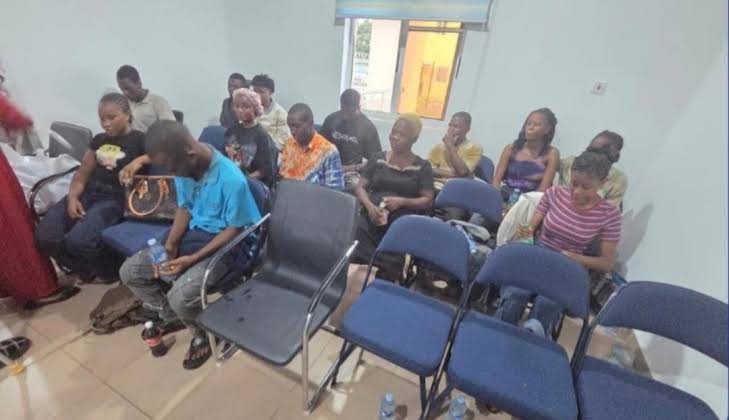
The release of 20 abducted National Youth Service Corps members in Imo State has been engulfed in controversy after the families of the victims revealed that they paid millions of naira in ransom, directly contradicting the police and Imo State Government’s claim that the corps members were rescued by security operatives.
The prospective corps members were abducted on October 1, 2026, when gunmen attacked two buses travelling from Ibadan to orientation camps in Abia and Akwa Ibom states along the Owerri-Onitsha Expressway. Following the abduction, the Imo State Police Command announced that its operatives had located the kidnappers’ camp through drone surveillance but could not immediately move in because the area was reportedly mined with improvised explosive devices. Commissioner of Police Audu Bosso said security forces were deploying additional operational assets, including bulldozers and armoured personnel carriers, to gain access to the location.
The corps members were eventually released on October 7, 2026, from the Amakohia-Ubi forest in Owerri West Local Government Area. The police said the release followed a coordinated operation involving the police, military, Department of State Security and other agencies. Governor Hope Uzodimma commended the security agencies for their quick intervention, expressing satisfaction with the collaborative efforts of both the Oyo and Imo state governments towards the quick release of the captives.
But the families of the victims tell a different story. A mother of one of the freed corps members, Alirat Wahab, told News Central Television that her family paid N6 million to secure her son’s release. She said the kidnappers initially demanded N50 million for each victim before eventually accepting N6 million for her son. “Initially, they asked us to pay N50 million per head. We asked whether the amount was for all of them, but they insisted that no, it was for each person,” she said. “Three days ago, they called and said we should pay N15 million. We kept begging them that all we had was N5.5 million. They said no and insisted on N6 million. So, it’s that N6 million we paid”.
Wahab said the abductors asked the parents to send representatives to meet them in Ibadan as part of arrangements for the ransom payment. “They called all the parents of all the victims. Twenty of them are in the bush. They then asked us to send three persons each to meet with them in Ibadan. My husband and my son’s elder brother went,” she said. “When they got to the meeting place, they asked them to send the money to an account and that when they got to Imo state, they should change the money into dollars”. She said her elder son met the kidnappers and personally delivered the ransom. “It was the brother who called us this evening to say that they had handed the ransom to the kidnappers and that they had released our son”.
Another parent, a farmer, said his family borrowed N6 million to pay the ransom. “I am excited that my son is coming back. However, how do I repay the N6 million I borrowed? I’m just a farmer,” he said. Some families reportedly paid between N3 million and N6 million to secure the release of their loved ones.
The disclosure directly contradicts the official narrative. Imo State Commissioner of Police Audu Bosso said he was not aware of any ransom payment. “The sustained pressure mounted by the security agencies eventually forced the abductors to release the victims,” Bosso said. The police had earlier claimed that the kidnappers’ camp was mined with IEDs, preventing an immediate rescue operation. Yet the corps members were released and walked out of the forest without any mines exploding.
The controversy has raised serious questions about the sincerity of the Federal Government and security agencies. The government never disclosed that any ransom was paid, instead announcing that the abductees were released to the Department of State Services, creating the impression that they were freed voluntarily. The conflicting accounts have raised questions about what actually led to the victims’ release and whether ransom payments were made.
For the families of the abducted corps members, the relief of having their children back is tempered by the financial burden they now carry and the knowledge that the government’s narrative does not match their reality. For Nigerians, the episode has reinforced a growing suspicion that the line between kidnappers and those who claim to be rescuing victims is not always clear. The corps members were taken, ransom was paid, and they walked out of a forest that the police said was too dangerous to enter. The official story says they were rescued. The families say they were ransomed. One of these accounts is true. The other is a lie. And the Nigerian public deserves to know which is which.
About The Author

Related Articles
Tinubu’s 30-Day Petrol Discount Sparks Fury as Nigerians Accuse Government of Electoral Bribe and Propaganda
The Federal Government’s announcement of a 30-day discount on petrol at NNPC...
Cameroon Commits to Stronger Bilateral Ties with Nigeria
Cameroon has reaffirmed its commitment to strengthening bilateral relations with Nigeria, pledging...

Ghana Borrows $288 Million at 11% to Pay Cocoa Farmers After Delayed Purchases
Ghana’s cocoa regulator has been forced to borrow 3.39 billion cedis, about...

Burkina Faso President Ibrahim Traoré Defies FIFA, Vows to Intervene in Football Federation After 7-0 Argentina Humiliation
Burkina Faso’s military leader, Captain Ibrahim Traoré, has vowed to intervene directly...
Leave a comment