




More than a decade ago, international observers looked at Africa’s economic engine and declared its choice of leadership an unmitigated tragedy. In 2015, The Economist famously told the world that Nigerians were cornered into picking between “Goodluck Jonathan, an utter failure, and Buhari, a former dictator.”
Looking back at that cynical moment, the current political landscape offers no relief. As Nigeria approaches its next major political crossroads, the nation’s electorate is trapped in an even more complex three-way deadlock. It is a political drama that has essentially been running since the early 2000s, as the same powerbrokers and institutional contradictions continue to dominate the ballot.
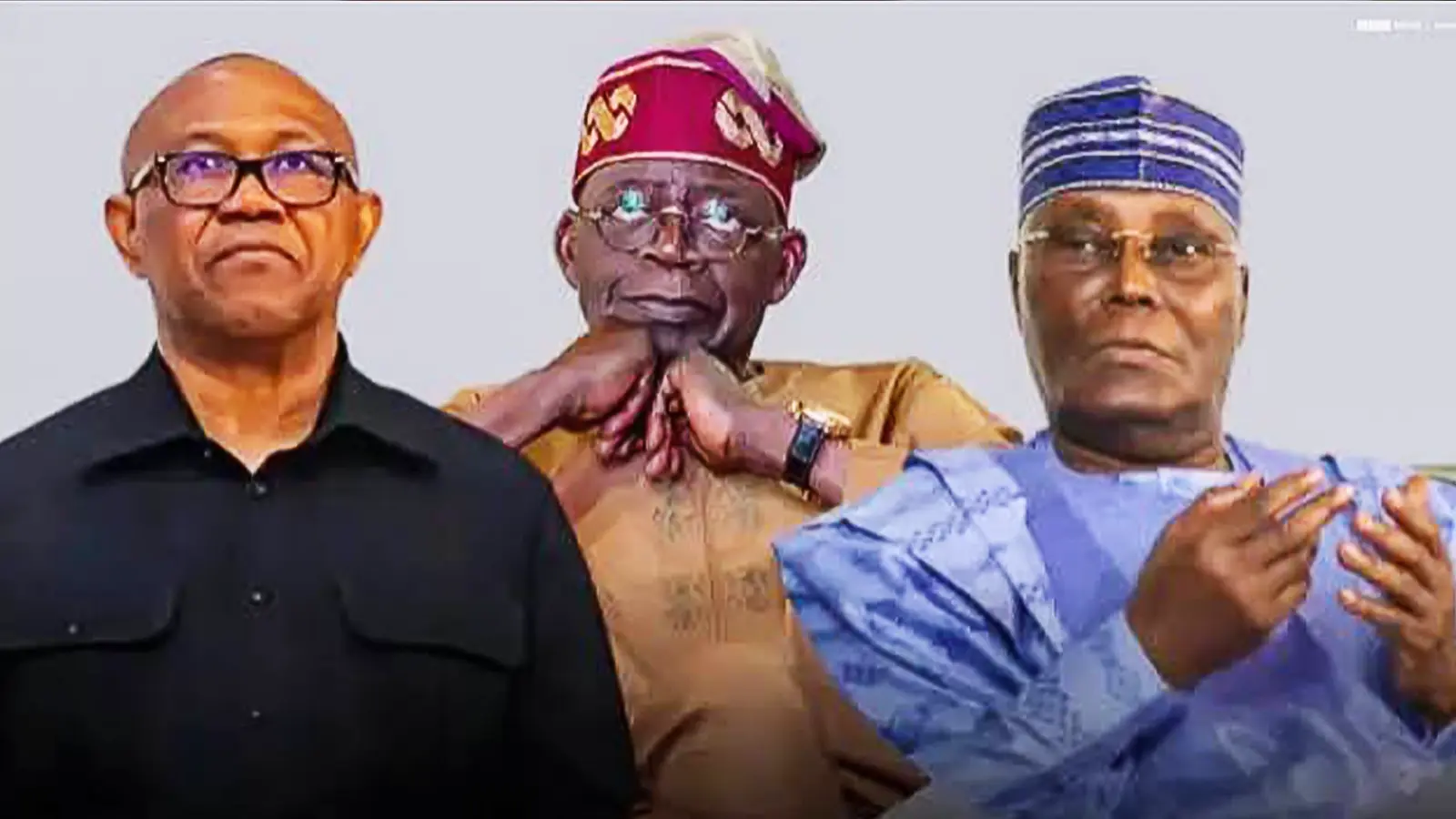
Today, the choice lies between an incumbent president presiding over unprecedented financial ruin, a perennial challenger burdened by international financial investigations, and an insurgent populist whose platform seeks to dismantle the two-party system. For citizens in the markets of Lagos or the streets of Abuja, democracy has increasingly begun to resemble an elaborate trap.
While macroeconomists and foreign investment bankers trade technical jargon regarding fiscal correction, the human cost of Nigeria’s current governance is impossible to ignore. The question facing the country is no longer who can lead them to prosperity, but rather, which brand of systemic dysfunction they are willing to endure.
At the epicenter of the national crisis stands Bola Tinubu. Sweeping into power on the back of his formidable political machinery, Tinubu promised to apply the same “Lagos blueprint” that transformed Nigeria’s commercial hub into a regional powerhouse. Instead, his administration introduced a fiscal shock that has plunged the populace into the worst economic state in generations.
By immediately terminating the decades-old petroleum subsidy and floating the national currency, the naira, Tinubu triggered a catastrophic economic realignment that has devastated everyday survival. Food inflation has skyrocketed to historic highs, the cost of basic transit has quadrupled, and small businesses have collapsed en masse under the weight of soaring operational costs.
To his supporters, this is the brutal, unavoidable medicine required to save Nigeria from structural bankruptcy. Opponents argue that it is a reckless, unmitigated disaster that has crushed citizens while the political class continues to indulge in luxury expenditures, from presidential jets to multi-billion naira renovations.
Yet, it is not just the economy that clouds Tinubu’s presidency; it is his history. Public records and international dossiers continuously point to a 1993 case in Chicago, where Tinubu surrendered $460,000 to the United States government after federal investigators tied his bank accounts to the proceeds of a heroin trafficking ring. Though his legal defenders accurately maintain that he was never formally indicted, criminally charged, or convicted, the drug-related settlement remains a permanent ethical shadow over his office. For a population weathering unprecedented financial misery, this history deepens a profound crisis of institutional trust.
Waiting to exploit the public’s boiling frustration is Atiku Abubakar, the veteran former Vice President embarking on yet another relentless campaign for the presidency. It is a quest for power he has pursued sequentially across nearly every electoral cycle, having been running for the highest office since the early 2000s.
Atiku positions himself as the sophisticated alternative—a billionaire businessman who understands how to deregulate markets and attract foreign capital without breaking the back of the working class. However, Atiku’s political brand is weighed down by decades of international scrutiny. He is a politician permanently framed by Western institutions as the archetype of the old-guard plutocrat.
Most notably, a comprehensive 2010 report by a United States Senate permanent subcommittee on investigations detailed how Atiku, through a web of offshore shell companies and wire transfers, allegedly channeled over $40 million in “suspect funds” into America. His name remains tethered to legendary international corporate bribery trials, including the infamous Siemens scandal.
While Atiku vigorously rejects these claims as politically motivated fabrications engineered by domestic rivals, the international documentation presents an alternative narrative. To a highly skeptical young electorate, Atiku does not represent salvation from Tinubu’s economic missteps; he represents a return to a transactional era of governance where state resources were routinely privatized into the hands of a wealthy, well-connected elite.
For the millions of younger, urban Nigerians who are equally repulsed by Tinubu’s economic policies and Atiku’s old-school networks, Peter Obi emerged as a political savior. Leading the Labour Party, Obi built a massive, fervent grassroots movement called the “Obidients.” His platform is anchored on a philosophy of extreme austerity, public accountability, and moving Nigeria “from consumption to production.”
Yet, international media and forensic journalists have revealed that Obi’s carefully curated image of a modest, transparent outsider does not entirely match his financial practices. Obi faces persistent scrutiny from fact-checkers for his routine inflation of economic statistics during public lectures, alongside local administrative disputes over the true state of the finances he left behind in Anambra.
Beyond his personal contradictions, Obi’s greatest political liability is his failure to build bridges. By refusing to compromise or form a unified opposition front with Atiku, Obi has fractured the anti-incumbent vote. Analysts argue that his uncompromising stance has inadvertently handed the ruling party a structural advantage, keeping the fractured opposition from mounting a cohesive challenge.
Nigeria’s democracy remains a high-stakes experiment where the choices are rarely pure. The tragedy of this contemporary political setup, which has essentially been running on a loop since the 2000s, is that each candidate represents a different facet of the country’s historic struggle.
Voters are left to choose between an incumbent enforcing a devastating economic contraction while carrying an unresolved drug-related past, a veteran establishment figure haunted by international corruption dossiers, and a populist reformer whose claims of total transparency are undermined by structural political fractures. As the nation navigates severe inflation and widespread institutional weariness, the upcoming electoral cycle offers no easy answers.
Just as in 2015, the ballot paper presents a choice where every viable box requires the electorate to compromise on its principles, proving once again that in Africa’s most populous nation, the path forward is always paved with bitter choices.
About The Author


Leave a comment