








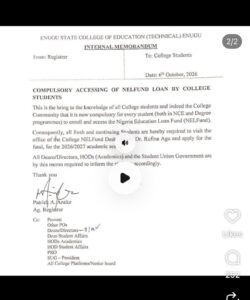
A fresh scandal has erupted over President Bola Tinubu’s student loan scheme after a state-owned college in Enugu was exposed for making the Nigeria Education Loan Fund compulsory for all students, threatening to bar those who refuse from taking examinations or force them to drop out entirely.
The Enugu State College of Education (Technical) issued an internal memo and circulated WhatsApp messages directing all students at the Nigeria Certificate in Education and degree levels to apply for the loan. Students who fail to comply were told they would face examination bans or expulsion. The directive sparked immediate outrage, with affected students calling on the government and the college authorities to explain why they were being forced into debt.
The Nigerian Education Loan Fund has since distanced itself from the college’s directive, insisting that the loan scheme is voluntary and meant only for students who genuinely need financial assistance. NELFUND warned that making the loan compulsory for all students, regardless of their financial circumstances, contradicts the scheme’s fundamental purpose. The agency said students who can fund their education on their own are under no obligation to apply and can continue their studies without taking on any debt.
But the damage has already been done. The Enugu college’s directive has confirmed the worst fears of critics who warned that the loan scheme would be used to trap students in a cycle of debt while masking the government’s failure to properly fund education.
Nigerians have pointed out that the scheme is not funded by new money. It is financed by diverting resources from the Tertiary Education Trust Fund and using cash recovered by the Economic and Financial Crimes Commission. TETFund, which was established to improve infrastructure, train staff and fund research in public tertiary institutions, has seen 30 per cent of its annual revenue redirected to NELFUND. By October 2026, TETFund had released more than N300 billion to the loan scheme. The Academic Staff Union of Universities has repeatedly warned that suffocating TETFund to fund student loans will destroy public education.
The Enugu college scandal also raises a deeper question about the government’s priorities. Instead of properly funding public institutions so that students can learn without incurring debt, the Tinubu administration has built a loan scheme that is now being used by colleges as a condition for sitting exams. Students who cannot afford to pay their fees are being forced to borrow, and students who can afford to pay are being told they must borrow anyway. The result is a system that pushes young Nigerians into debt before they have earned their first salary.
The timing is particularly damning. The scandal broke just days after the government announced that more than 1.2 million students are benefiting from NELFUND. The government has presented the scheme as a success story, a testament to its commitment to education. But the reality on the ground is different. Students are being threatened with expulsion for refusing to take loans they do not need. Colleges are being allowed to act as debt collectors for a federal agency. And the government is silent.
Former Vice President Atiku Abubakar has described the loan scheme as a liability and accused the Tinubu administration of using it as a shield against proposals to reduce the cost of education. He has promised to review the scheme and offer debt forgiveness to students if elected in 2027. The Enugu college scandal gives his argument fresh urgency.
The Tinubu administration came to power promising free education and student loans that would ensure no Nigerian child dropped out because of school fees. What it has delivered is a scheme that is funded by raiding other education funds, administered in a way that traps students in debt, and now being used by institutions to threaten students with expulsion. The government must immediately investigate the Enugu college’s directive, hold those responsible accountable, and clarify that no student will be forced to take a loan against their will. But more than that, it must explain why it is asking students to borrow money to sit in classrooms that the government refuses to fund.
READ MORE: Tems Breaks Billboard Record as ‘What You Need’ Becomes Longest-Charting Solo African Song
About The Author







Leave a comment