



Aaron Greenspan Accuses Tinubu of Lying to Court Over 1993 Political Status in FOIA Case
 West Africa WeeklySeptember 30, 20263 Mins read15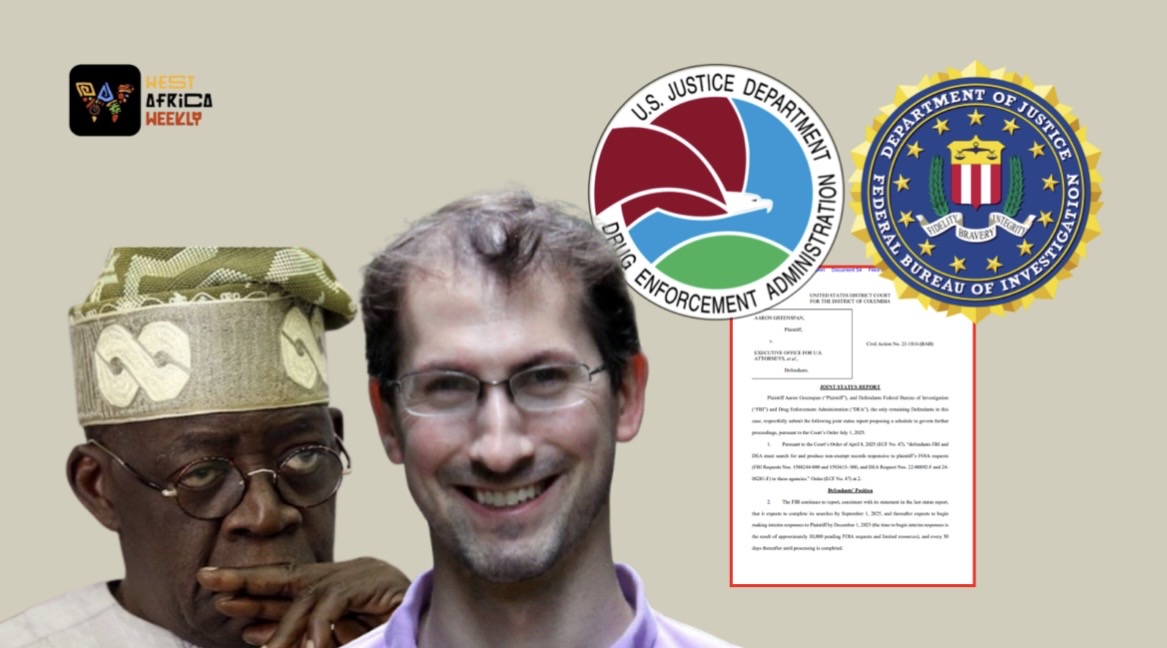
Aaron Greenspan, who is pursuing a Freedom of Information Act lawsuit against the FBI and Drug Enforcement Administration, has accused President Bola Tinubu of lying to a United States federal court about his political status in 1993. Greenspan alleges that Tinubu’s lawyers told a judge he had never been involved in politics or held elected office that year in order to claim privacy protections for records from that period.
Greenspan made the claim during an interview with former presidential spokesman Laolu Akande on Channels Television’s “Inside Sources.” He said the statements were made in a court filing dated August 28, 2026. “The most recent thing that I think has come up that I have not seen any headlines about, much to my surprise, is that Mr. Tinubu lied to the court,” Greenspan said. “And he did that on August 28th when his lawyer informed the court that he had never been in politics in 1993, that he had never held elected office during that year. And that’s simply untrue as far as I can tell.”
Greenspan said public records and Tinubu’s own biography contradict the court filing. He stated that Tinubu was elected to the Nigerian Senate in 1992 and was serving in that capacity in 1993. “My understanding is that Mr. Tinubu was in the Nigerian Senate in 1993 and he in fact was elected in 1992. And he admits this himself,” Greenspan said. “There are documents from the Nigerian government where his own autobiography, as he calls it, says that he was elected to the Senate in 1992.”
Tinubu was elected to the Senate in 1992 on the platform of the Social Democratic Party, representing Lagos West. He was one of the prominent senators who opposed the annulment of the June 12, 1993 presidential election. After the military dissolved the political institutions later that year, he became a founding member of the National Democratic Coalition, the pro-democracy group that campaigned for the restoration of democracy and the recognition of Moshood Abiola as the winner of the June 12 election.
According to court documents, Tinubu’s legal team, led by Christopher W. Carmichael, Victor P. Henderson and Oluwole O. Afolabi, argued in the August 28 filing that the information sought by Greenspan concerns law enforcement records about Tinubu as a private citizen and does not shed light on how US agencies performed their official duties. They argued that releasing the material could constitute an unwarranted invasion of privacy and cited FOIA Exemption 7(C), which protects law enforcement records from disclosure when it could reasonably be expected to invade personal privacy.
The lawyers placed particular emphasis on Tinubu’s status at the time. “Regardless, Intervenor should retain his full privacy interests because he was not a public official in 1993,” they argued, adding that the requests concern “three decades old records pertaining to events that occurred when Intervenor was a student.”
Greenspan said the contradiction matters because Tinubu is claiming privacy rights that apply to private citizens rather than public officials. “He’s going to court now and telling this federal judge that he was not in politics and therefore he should have privacy rights from that era like any other citizen would,” Greenspan said. “That’s problematic because there’s evidence of course to the contrary and I think it’s surprising that a head of state would come into an American court and say something so obviously provably false.”
Greenspan also raised questions about how the filing was prepared. He suggested the brief submitted by Tinubu’s attorney may have been written by artificial intelligence, noting what he described as “AI-type errors” in the document. He also pointed out that Tinubu claimed rights under the Privacy Act, which only applies to US citizens, while Tinubu is a Nigerian citizen.
The case, Greenspan v. Executive Office for U.S. Attorneys, is a civil dispute over access to government records and is not a criminal prosecution of Tinubu. Greenspan is seeking the FBI’s entire file on Tinubu and FBI Form 302 interview records covering the period between 1992 and 1993, as well as records linked to a 1993 civil forfeiture proceeding in which about $460,000 was seized from an account in Tinubu’s name. Tinubu has denied wrongdoing and was never criminally charged or convicted.
The court is expected to determine whether the FBI and DEA may retain their redactions and withholdings on the records or whether further documents sought by Greenspan must be released.
About The Author


Related Articles

Barrick Reaches Deal With Mali Unions to Avert Strike at Loulo-Gounkoto as Government Tightens Grip on Gold
Barrick Mining has signed a new collective bargaining agreement with unions at...
Guinea-Bissau’s Ousted President Embalo to Return From Exile and Run in December Election
Guinea-Bissau’s exiled former president, Umaro Sissoco Embalo, has announced that he will...

Nigeria Grows 2.3 Million Tonnes of Tomatoes and Still Spends $360 Million Importing Paste
Nigeria is Africa’s second-largest tomato producer. The country grows about 2.3 million...


FG Approves Upgrade of Onne, Rivers, Delta, Calabar Ports, Another Promise That May Never See Daylight
The Federal Government has approved the comprehensive modernisation and upgrade of Onne,...
Leave a comment