







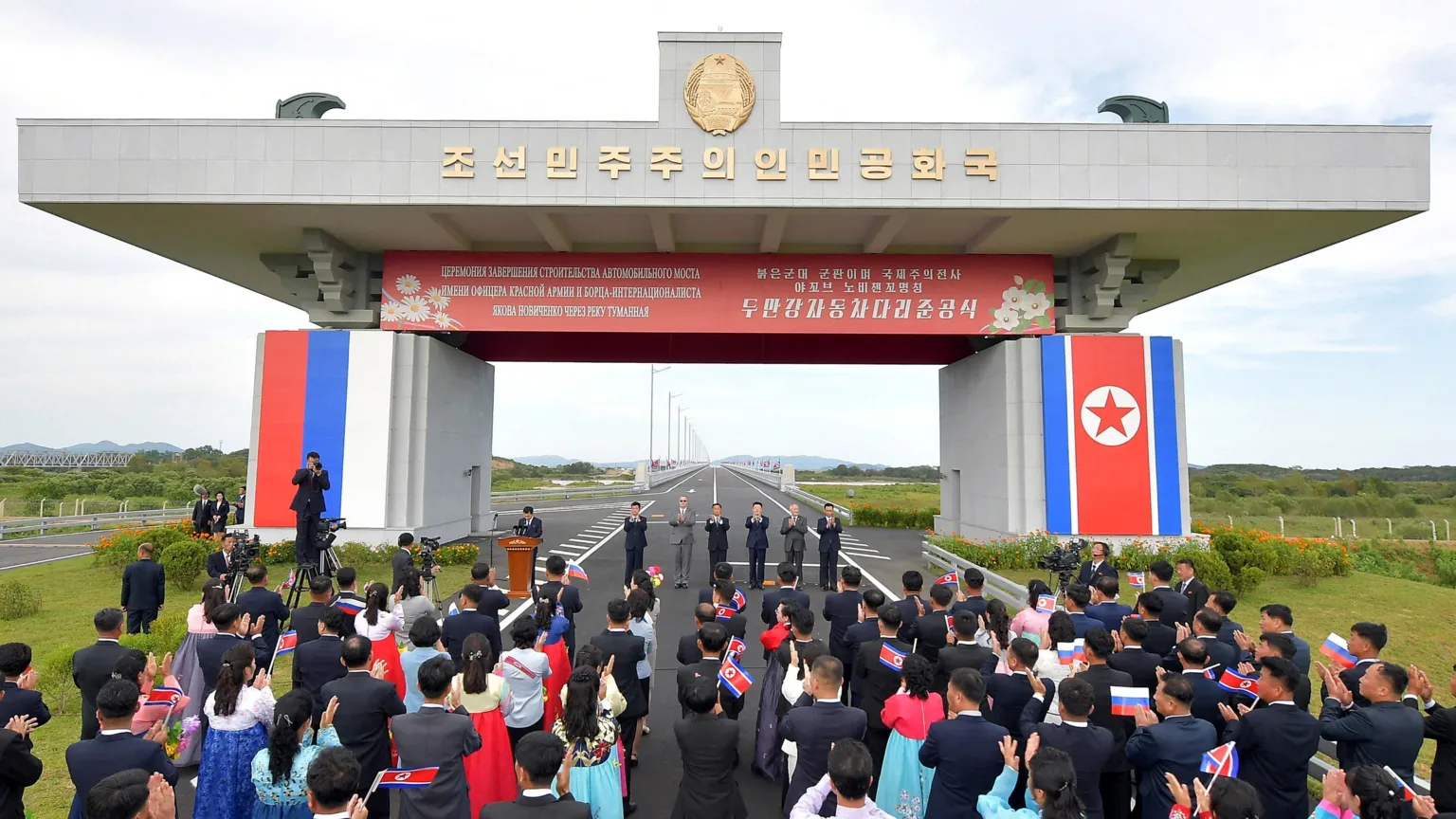
Russia and North Korea have opened the first road bridge linking the two countries across the Tumen River, a development that officially aims to boost trade and tourism but has triggered widespread alarm over its potential use as a covert military logistics corridor to support Russia’s war in Ukraine.
The bridge, which took 495 days to build, was inaugurated on Monday in a ceremony attended by officials from both countries. Russian Prime Minister Mikhail Mishustin described it as a “new symbol of friendship” and said ties between Moscow and Pyongyang were “at an unprecedented high level.” North Korea’s Prime Minister Pak Thae Song called it a “historical event.” Pyongyang’s state media said the bridge would be used for “personnel exchanges, tourism and trade.”
But Ukrainian investigative organisation Truth Hounds has warned that the bridge is intended “primarily to establish a covert military logistics corridor” to support Russia in the Ukraine war. The group said that given the strategic partnership treaty signed by Russia and North Korea in 2024, the bridge could be used to transport North Korean military personnel, construction workers and senior military officials directly into Russia.
The bridge spans about one kilometre across the Tumen River and forms part of a 4.7-kilometre road network including access roads, a border checkpoint and parking facilities. It has two lanes and can handle up to 300 vehicles and 2,323 people daily, with capacity potentially expandable to 800 vehicles. Until now, the only road link between the two countries was a makeshift arrangement where wooden planks were placed on the rail bridge to allow cars to cross.
READ MORE: Only Two African Players Nominated for 2026 Men’s Ballon d’Or
The opening comes amid rapidly expanding military cooperation between Moscow and Pyongyang. Researchers at South Korea’s spy agency estimate that North Korea has already transferred between $7 billion and $14 billion worth of rockets, missiles and artillery shells to Russia using ships. An estimated 11,000 North Korean troops are currently fighting alongside Russian forces in Ukraine. Russian forces have also been using North Korean short-range KN-23 ballistic missiles in nightly attacks, according to the Ukrainian air force.
South Korean government officials have expressed strong concern that the bridge will make it easier to transport military supplies by truck, potentially allowing North Korea to move ammunition and missiles under the cover of night to evade satellite surveillance. The bridge could also provide a direct land route for North Korean labourers heading to Russia. Around 10,000 North Koreans are already working in Russian construction sites and logging camps, according to South Korean estimates, despite a UN ban on the use of North Korean labour. Many enter Russia under the guise of student visas.
The bridge also carries a broader geopolitical message. Experts have noted that it signals to the United States that North Korea has no reason to seek sanctions relief or make concessions on denuclearisation in order to negotiate. For Russia, the bridge represents a strategic asset that could facilitate military exchanges and possibly serve as Moscow’s pledge to help North Korea in case of a contingency.
The project was agreed during Russian President Vladimir Putin’s visit to North Korea in 2024, his first trip to the state in 24 years. Construction began in 2025 and faced delays before completion. While Russia and North Korea present the bridge as a symbol of friendship and economic cooperation, the concerns raised by Ukraine, South Korea and Western intelligence agencies suggest its primary purpose may be far more consequential. For a region already destabilised by North Korea’s nuclear programme and Russia’s war in Ukraine, the new bridge represents yet another escalation in the growing military alignment between two of the world’s most sanctioned states.
About The Author





Leave a comment