







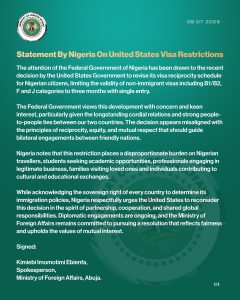
The Nigerian government is under fire for its perceived weak and directionless response to the United States’ recent decision to significantly reduce visa validity for Nigerian citizens. The new U.S. policy limits non-immigrant visas, including B1/B2, F, and J categories, to just three months with single entry, disrupting travel plans for thousands of Nigerians across education, business, and family sectors.
In response, the Ministry of Foreign Affairs issued a carefully worded statement urging the United States to reconsider the decision. While calling for mutual respect and cooperation, the statement offered no substantive proposals, reciprocal measures, or clear diplomatic strategy, with many questioning Nigeria’s capacity to respond effectively to major international developments.
Compounding the issue is Nigeria’s failure to appoint ambassadors, a diplomatic vacuum that has persisted for months under President Tinubu’s administration. At a time when strategic diplomacy is urgently needed, Nigeria’s most crucial foreign posting remains vacant. The absence of high-level representation in the U.S. has limited Nigeria’s ability to engage meaningfully or push back through proper diplomatic channels.
This failure reflects a broader lack of seriousness in Tinubu’s approach to foreign policy. Despite promises of renewed international engagement, the administration has yet to demonstrate a coherent diplomatic agenda. Key positions remain unfilled, and foreign missions remain underfunded and directionless.
Nigerian citizens affected by the policy have received little to no support. Students preparing for U.S. university admissions, business travellers, and families have all been left scrambling, with embassies providing minimal guidance or assistance.
This situation underscores a more profound crisis in Nigeria’s foreign policy posture:
One of institutional neglect and executive indifference. While the visa restrictions came swiftly and decisively from Washington, Abuja’s response has been slow, reactive, and largely symbolic.
Until the Tinubu administration demonstrates real investment in diplomacy through timely appointments, policy reforms, and credible engagement, Nigeria’s influence on the global stage is likely to continue its decline.
About The Author





Leave a comment