



For The First Time Ever Nigeria’s Ginger Export Fell From N26 Billion To Zero Under Tinubu’s Government Despite Being The World’s Top Producer
 West Africa WeeklyMay 22, 20263 Mins read1.3k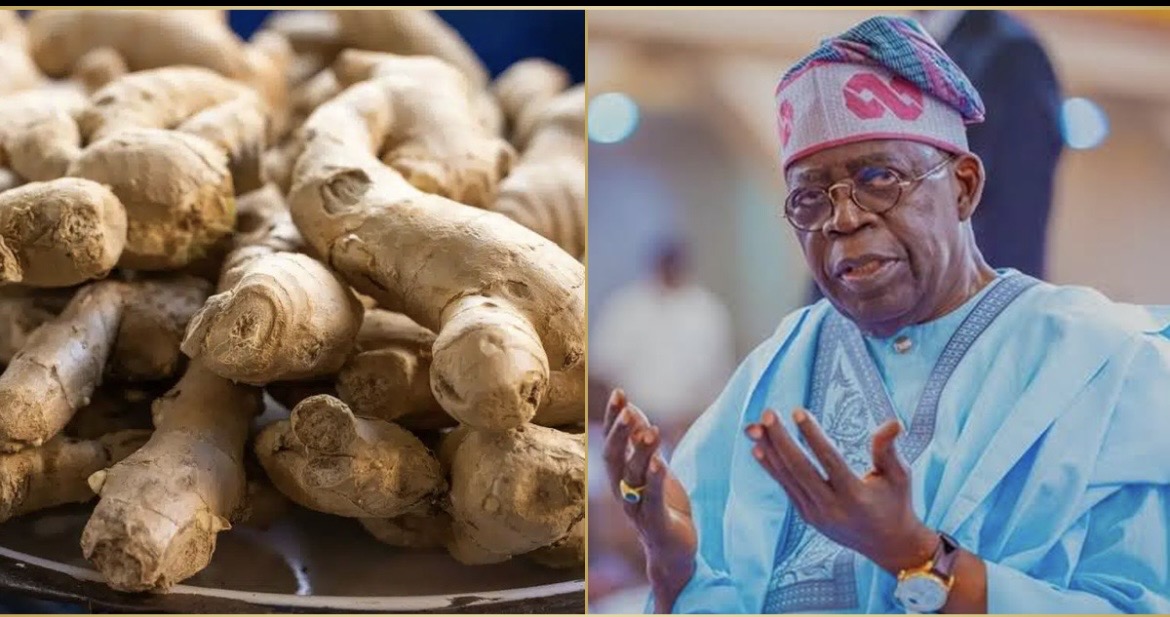
Nigeria was once the world’s third largest producer of ginger and the undisputed leader in quality. The native varieties Tafin Giwa and Yatsun Biri were prized globally for their high oleoresin content and intense pungency. Buyers from Europe, America and Asia paid a premium for Nigerian ginger because nothing else on the market had its heat or aroma. That era is over. Under President Bola Tinubu’s watch, annual ginger export earnings have fallen from N26.2 billion to absolutely zero.
The collapse is not an exaggeration. Data from the National Bureau of Statistics confirms that export revenue dropped from N6.28 billion in 2024 to zero by the end of 2025. A fungal blight known as Proxipyricularia zingiberis swept through Kaduna, Plateau and Nasarawa states starting in 2023, destroying an estimated 85 to 95 percent of the national harvest. Farmers who once filled three lorries from a single field now struggle to fill a single bag.
The reasons for the wipeout are not mysterious. Nigeria had no national ginger seed bank, no early warning system for fungal disease, no crop insurance for smallholder farmers, and no emergency response plan. Insecurity across the ginger belt drove many farmers off their land. Production costs soared to more than 10,000 dollars per metric ton while the global market price sat at around 2,000 dollars. Nigerian ginger became too expensive and too scarce to sell anywhere in the world. Ethiopia has already taken over Nigeria’s former export contracts.
Under Tinubu’s government, there has been no comprehensive recovery plan. Farmers say they have received no relief. Florence Edwards, president of the ginger growers association, told reporters that intervention funds never reached actual farmers.
Those who supposedly received funds were not actual farmers but political appointees, she said. John S. Hatan, a farmer in Kaduna’s Kachia area, used to plant 150 bags of ginger seeds before the outbreak. This year he planted just ten. It is as if ginger production is coming to an end,” he said.
As the industry collapsed, Nigerians took to social media to demand answers. In the absence of any official explanation, alternative theories spread rapidly. A post by user @nostalgicvibeng on May 22, 2026, claimed that USAID brought in contaminated inputs that destroyed the ginger farms. Another user, @pshegs, posted a detailed thread arguing that what people call GMO is actually an imported patented hybrid that cannot reproduce, forcing farmers to buy new seeds from foreign suppliers every season. He also wrote that the inputs sponsored by the international community weakened the soil and the natural ginger, and that those who did not accept the inputs did not experience the problem.
So, let me help:
First, I spoke about this extensively in 2025 after a series of deep posts here on X.
1) there is no GMO ginger in a manner of speaking. What we call GMO is actually an imported hybrid that lacks pungency, and is absolutely not as efficient or effective as the… pic.twitter.com/hRYE1pVg1z
— pshegs (@pshegs) May 22, 2026
Other posts went further. @onu_slim alleged that grant funded agricultural interventions arrived with GMO organisms that deliberately weakened indigenous crops and compromised soil health. @El_matadorre referenced a documentary in which farmers described cheaper seeds distributed by whitemen and concluded that the white race never gives anything for free.
In one of the documentaries on this scenario, it was reported that ‘’cheaper seeds were distributed by whitemen’’ the farmers described it. This is the lesson that Africans refused to learn the white race never gives anything for free their is always an agenda behind it 🤷♂️
— Aminullahy (@El_matadorre) May 21, 2026
These claims are widely shared but not substantiated by agricultural agencies or peer reviewed studies. Scientists point out that no commercial GMO ginger exists anywhere in the world. The Bill and Melinda Gates Foundation has pledged billions to African agriculture, but there is no public evidence linking any of its programs to the ginger blight. The fungal pathogen that caused the collapse is a naturally occurring organism, not a synthetic biological weapon. As for the patented hybrid seed, there is no official record of the Tinubu government introducing such a seed as a response to the crisis. The accusation remains a theory circulating online, born from farmer desperation and government silence.
The distinction between fact and speculation matters. What is not speculation is this: under Tinubu’s watch, Nigeria lost an entire export industry. What is not speculation is that farmers received no help. What is not speculation is that Chinese ginger now floods local markets, pale and tasteless compared to what Nigeria once grew. What is not speculation is that the fields that produced the world’s best ginger now grow maize, beans or nothing at all.
Tinubu’s government has not issued a public statement addressing the collapse. No minister has visited the ginger belt. No investigation has been launched. The conspiracy theories will continue to spread because the government has offered nothing to stop them. The ginger is gone. The silence remains. And Nigeria’s place as the world’s best ginger exporter is now only a memory.
About The Author



Related Articles
Cameroon Commits to Stronger Bilateral Ties with Nigeria
Cameroon has reaffirmed its commitment to strengthening bilateral relations with Nigeria, pledging...
Ghana Borrows $288 Million at 11% to Pay Cocoa Farmers After Delayed Purchases
Ghana’s cocoa regulator has been forced to borrow 3.39 billion cedis, about...

Burkina Faso President Ibrahim Traoré Defies FIFA, Vows to Intervene in Football Federation After 7-0 Argentina Humiliation
Burkina Faso’s military leader, Captain Ibrahim Traoré, has vowed to intervene directly...

Ghana Approves Formal Application to Join BRICS as Cabinet Backs Mahama’s Economic Diversification Drive
Ghana’s cabinet has approved a decision to formally apply to join BRICS,...
Leave a comment