


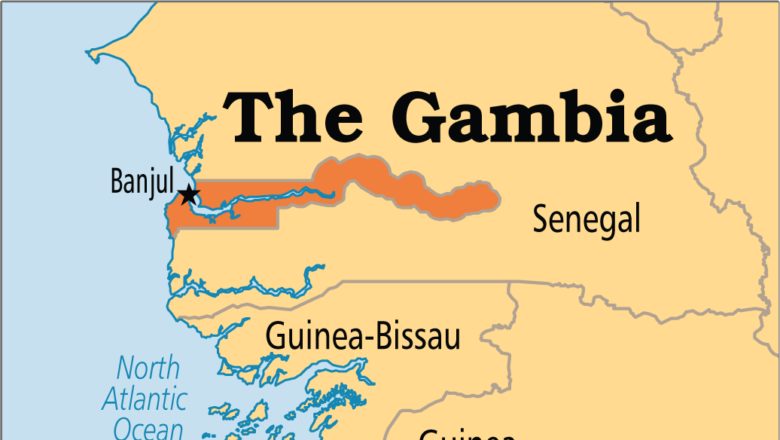
Gambia’s police chief has banned all public protests without official permits after days of violent demonstrations over prolonged power cuts, a move that critics say is aimed at silencing growing frustration with President Adama Barrow ahead of December’s election.
Inspector General of Police Seedy Mukhtar Touray announced the ban in a statement late Thursday, saying no one would be allowed to gather or protest without an approved permit, especially at night. “Any violation to this will be met with necessary force,” he warned. The statement came after authorities used tear gas earlier in the week to disperse crowds that had gathered in Banjul and surrounding towns to denounce blackouts that have lasted up to 48 hours during the country’s hottest months.
The protests, which began on Monday night and continued over several nights, highlighted deep frustration with Barrow, who is seeking a controversial third term in the December 5 presidential election. In Banjul, protesters burned tyres, erected barricades and chanted “Barrow must go!” as they marched toward the heavily guarded State House. In Farato, a town about 30 minutes from the capital, demonstrators gathered outside the residence of Vice President Mohammed B.S. Jallow and destroyed banners at an office of Barrow’s ruling National People’s Party. Police fired tear gas near the Westfield area of Banjul to disperse crowds.
During the unrest, a police post was vandalised and detainees were unlawfully released from custody, Touray said. The national utility, the National Water and Electricity Company, closed three branches after attacks severely damaged buildings, infrastructure and office equipment. Authorities have arrested 11 people in connection with vandalism during the unrest.
The roots of the crisis stretch back years. The Gambia has long relied on electricity imports from Senegal and Guinea to supplement its own ageing and underfunded generation capacity. Senegal has supplied mostly rural parts of the country since 2017, and Guinea joined the electricity mix through the Gambia River Basin Development Organisation network in October 2024. But supplies from both have fallen recently, reportedly over NAWEC’s unpaid bills to Senegal’s national electricity company and, in Guinea, lower rainfall affecting hydropower generation.
The situation worsened in mid-August when NAWEC said it was experiencing an “unforeseen surge in electricity demand during the peak period,” which it attributed to high temperatures. The utility’s managing director, Gallo Saidy, later said the prolonged cuts were due in part to climate change and the US-Israel war on Iran, while appealing to Gambians for patience.
Sanwo-Olu Blames Cranes and & ‘Iconic Cane’ as Ojota-Opebi Bridge Misses Another Deadline
Barrow has declared the outages a “national security issue” and an emergency. During a visit to a NAWEC power station on Tuesday, he promised that new generators would arrive this week and that electricity would be restored by the end of October. He said the government was in the final stage of installing an additional 24-megawatt generation machine at the Brikama power station and had awarded a contract for a 50-megawatt solar plant in Soma. In a televised address to the nation, Barrow acknowledged the widespread hardship. “I know that the fans have stopped turning, children work in the dark, mothers throw away stale food, and the heat is unbearable by day and by night,” he said. “Let us not destroy in a moment of anger what we suffered so long to gain.”
Information Minister Ismaila Ceesay offered a formal government apology, saying officials were working relentlessly to restore stability. But opposition figures say the crisis reflects deeper failures. Talib Ahmed Bensouda, mayor of Kanifing Municipality, who plans to challenge Barrow in December, told Reuters he understood why protesters were upset. “If you can’t sit in your house because of the heat. If you don’t have a generator to do basic business or even to carry out informal activities, you’re forced to take the matter to the streets,” he said. Bensouda faulted Barrow for relying too much on energy imports, leaving the country exposed to global supply disruptions. “Youths are frustrated, and I think not just about energy, they’re frustrated about a lot of things,” he said. “There’s a lack of opportunity and this is what’s driving irregular migration to Europe.”
The protests and the government’s response have drawn international attention to the political stakes in Gambia, a small West African nation still navigating its democratic transition after more than two decades of authoritarian rule under Yahya Jammeh. With Barrow facing questions over the constitutionality of his third-term bid and public anger over basic services mounting, the December election is shaping up as a referendum on his leadership. The police ban on protests without permits has raised fresh concerns about the space for dissent as the vote approaches. For Gambians who spent days in the dark and then took to the streets, the government’s promise to restore power by October may be the only thing that can quiet the chants of “Barrow must go.”
About The Author



Leave a comment