




Backlash Grows as Nigerian Army’s Allegedly ‘Fabricated’ Imo Operation Fuels Tribalism
 West Africa WeeklyMarch 15, 20262 Mins read11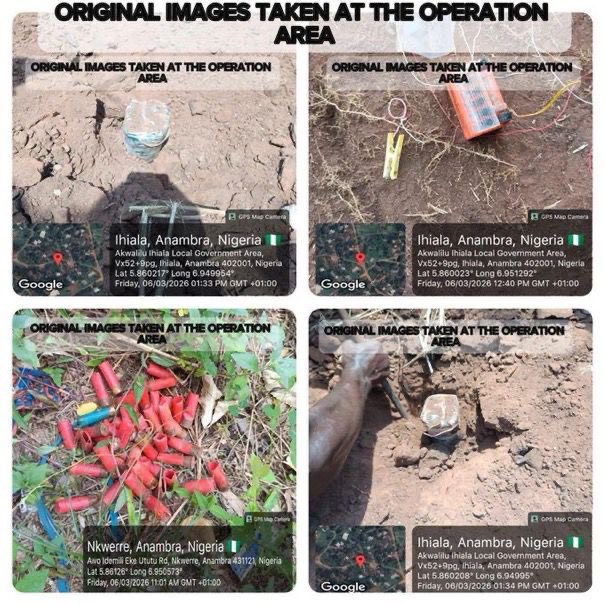
The Nigerian military is rapidly losing credibility amid allegations that Bola Tinubu’s administration is presiding over widespread tribalism. Public distrust has grown stronger due to conflicting reports relating to a significant security operation in Nigeria’s South East.
On March 12, 2026, the Nigerian Army announced that troops engaged in Operation UDO KA had successfully reopened the Lilu–Eketutu Road in Imo State, a vital route that had been closed for three years due to insurgent activity. The military also confirmed that its forces destroyed a major bomb-making facility believed to be linked to the Indigenous People of Biafra (IPOB) and its armed wing, the Eastern Security Network (ESN), in the Orsu–Ihiteukwa area of Imo State.
The announcement faced some initial concerns, with critics highlighting potential geographical inconsistencies and questioning the authenticity of certain evidence. Social media users suggested that some photos presented by the military to illustrate the Imo State operation might have been taken in Ikorodu, Lagos, and raised the possibility that the image metadata had been intentionally edited to obscure the actual location.
Skepticism intensified as users scrutinized the images purported to prove a dismantled bomb factory. They contended that the items in the photographs were simply ordinary household batteries and electrical wires, not advanced explosive devices. These assertions strengthened accusations that the military was inflating or fabricating operational successes to justify its presence and actions in the region.
In an effort to counter what it called propaganda, the Army released what it claimed were “original images” with GPS tags on March 15, 2026. This move, however, ignited further controversy when one of the photographs was labeled “Nkwerre, Anambra, Nigeria.” citizens quickly pointed out that Nkwerre is widely recognized as being in Imo State, not Anambra State, exposing the military’s apparent inability to accurately identify the location of its own operation while attempting to dismiss misinformation allegations.
The controversy has been framed by some analysts as part of a larger debate on ethnic representation in Nigeria’s security leadership. Ugoji Egbujo and other commentators assert that key coercive institutions, including the Chief of Army Staff, the Inspector General of Police, and the Director General of the State Security Service, are exclusively led by individuals from the Yoruba ethnic group, the same as President Tinubu. This concentration of leadership positions as “prebendal tribalism,” warning that it significantly undermines meritocracy and threatens national cohesion.
The Nigerian military firmly denies these allegations. Spokesperson Olabisi Olalekan Ayeni asserts that the Army is unequivocally an apolitical, professional, and multi-ethnic institution. Officials unequivocally dismiss the circulating claims as IPOB propaganda and fake news aimed at sabotaging ongoing security operations.
To address the controversy, the Army has invited journalists and civil society organizations to participate in a verification tour of the Orsu–Eketutu Mother Valley, where it states recovered improvised explosive device (IED) materials can be inspected directly. Military officials emphasize that the initiative aims to demonstrate transparency and decisively counter what they describe as a “dying ember” of regional agitation.
Despite these assurances, the changing narratives about the operation’s location, spanning Imo State, Lagos imagery, and a misidentified Anambra GPS tag, have severely undermined public trust.
About The Author



Related Articles
Nigeria’s Power Crisis Deepens as GenCos Say Bola Ahmed Tinubu’s Government Owes Over ₦6 Trillion
Nigeria’s electricity crisis is worsening as power generation companies say the federal...
European Parliament Calls for Regime Change in Niger, and It’s Not About Democracy
The European Parliament adopted a resolution on March 12, 2026, calling for...

Ghana, Nigeria and South Korea Deepen Energy and Agricultural Cooperation
A growing partnership between Ghana, Nigeria and South Korea is highlighting the...

Ivory Coast Considers Reforming Cocoa Marketing System as Global Supply Increases
The government of Ivory Coast is considering major reforms to its cocoa...
Leave a comment