


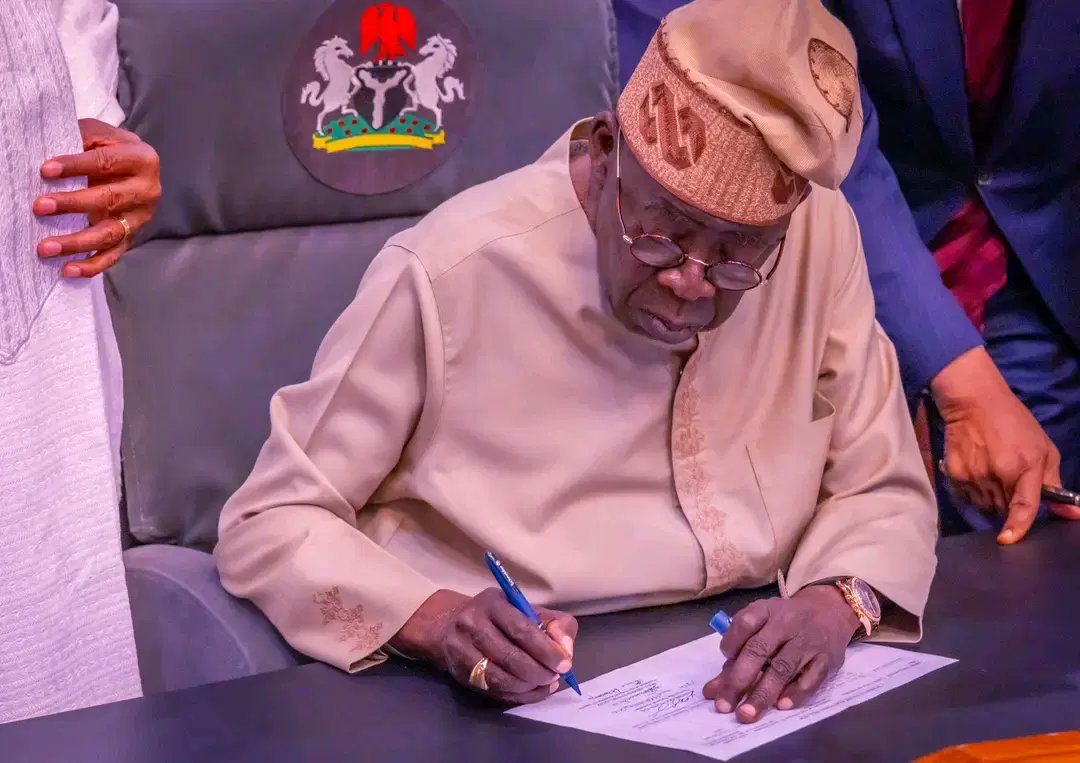
President Bola Tinubu has formally written to the Senate seeking approval to borrow a fresh $516,333,070 external loan. The request arrives just as his administration faces mounting criticism over a series of controversial financial decisions ahead of the 2027 elections.
According to a letter read on the floor of the Senate on Thursday by President of the Senate Senator Godswill Akpabio, the proposed loan is to be sourced from Deutsche Bank. It is specifically earmarked for financing the already approved Sokoto-Badagry 1,000 Super Highway project.
President Tinubu in the letter is asking for expeditious passage of the request. Akpabio has since referred the matter to the Committee on Local and Foreign Debts for legislative action, with a report expected back within one week.
The request has immediately drawn fire from opposition figures and civil society groups who see it as yet another addition to the country’s already ballooning debt profile. It comes on the heels of multiple borrowing sprees by the administration.
Former Vice President Atiku Abubakar has already raised strong objections to the loan request. He described it as fiscally irresponsible at a time when ordinary Nigerians are struggling with unprecedented economic hardship.
Atiku questioned the transparency of the borrowing plan and demanded that the National Assembly reject the request until full details of repayment terms and project execution timelines are made public. The Peoples Democratic Party has also warned that the loan will only deepen Nigeria’s debt burden without delivering tangible benefits to citizens.
The party pointed to the many abandoned road projects across the country that have swallowed billions of naira with little to show for them.
The $516 million loan request is not happening in isolation. It lands in the middle of a broader storm of financial controversies that have come to define the Tinubu administration’s preparations for the 2027 election cycle.
Just days ago, the government announced a ₦17 billion Community-Based National Social Action Fund for all 8,804 political wards across the country. The programme, announced by the Federal Ministry of Health and Social Welfare, is meant to empower local communities to identify and execute priority projects such as nutrition support, health commodities, minor school repairs, and sanitation improvements.
But Nigerians are not celebrating. The government has provided no public breakdown of how the ₦17 billion will be distributed per ward.
Who are the verified community based organisations that will manage the funds? By what criteria were they selected? Who monitors their accounts? What prevents a local government chairman or a ward level political thug from hijacking the process? None of these questions have been answered.
In a country where constituency projects have become notorious for disappearing into the pockets of politicians, Nigerians see the timing, an election year looming, and they see the lack of detail. It is a classic recipe for a vote buying slush fund dressed in development clothing.
Even more explosive is the N135.22 billion allocation hidden inside the 2026 national budget for Electoral Adjudication and Post Election Provision. This is a legal war chest placed under Service Wide Votes, a centrally managed pool of funds that the Federal Government uses to finance obligations not directly tied to any specific ministry, department, or agency.
The budget document shows that this fund is separate from the N1.01 trillion statutory transfer to the Independent National Electoral Commission. This makes the total financial firepower for the 2027 electoral cycle truly staggering.
The Resource Centre for Human Rights and Civic Education has criticised the allocation, describing it as troubling and questioning the government’s priorities in managing the electoral process. CHRICED expressed concern over what it termed a lack of transparency, pointing out that neither the purpose nor the framework for managing the funds had been clearly outlined.
Budgeting heavily for post election litigation suggests an expectation of electoral failure rather than a determination to prevent it, the group stated. They warned that setting aside such a substantial amount for election disputes sends the wrong signal about the integrity of the country’s electoral system.
Put these three financial approvals side by side, the fresh $516 million loan, the ₦17 billion opaque ward fund, and the N135 billion legal war chest, and a clear picture emerges. The administration is borrowing heavily, spending opaquely at the grassroots, and preparing for an unprecedented legal battle to defend the outcome of the 2027 polls.
Opposition parties have seized on this pattern. Senator Aminu Tambuwal has accused the administration of orchestrating a deliberate plan to weaken opposition parties and entrench one party dominance ahead of 2027. The African Democratic Congress has called for a full audit of all community based organisations that will serve as implementing partners for the ward fund.
The irony is not lost on critics who recall President Tinubu’s own history as a pro democracy activist during the military era. Tinubu was a key strategist and financier of the National Democratic Coalition, the defunct pro democracy group formed on May 15, 1994 to end military rule in Nigeria. He was forced into exile in 1994 and sold two filling stations he owned in London to fund the movement.
But now, former Labour Party presidential candidate Peter Obi has accused Tinubu and other NADECO members now in power of becoming present day destroyers of democracy. Yesterday defenders of democracy, today’s destroyers. What a shame. What an irony of history, Obi said on X.
READ MORE: Nigerians See the Truth, Tinubu’s ₦17 Billion Ward Money Is a Vote Buying Slush Fund
Today, General Sani Abacha, once presumed face of oppression, will be remembered as seemingly more democratic and more respectful of human rights than the so called champions of activism from the NADECO days. Power indeed reveals character.
As the Senate begins its consideration of the $516 million loan request, Nigerians are left to wonder where all the money is going. Borrowing for roads is one thing. Borrowing while simultaneously creating opaque ward funds and a multi billion naira legal war chest for an election that has not yet been held is quite another.
The opposition has vowed to resist, with Senator Elisha Abbo declaring that if the administration uses public funds to fight them, they will meet them on the battlefield. The National Assembly now faces a critical test, whether to approve yet another loan for an administration whose financial priorities increasingly appear aimed at securing electoral victory rather than serving the Nigerian people.
READ ALSO: Is Tinubu Preparing to Rig the 2027 Election? His Government Reserves N135 Billion for Lawsuits
About The Author


Leave a comment