







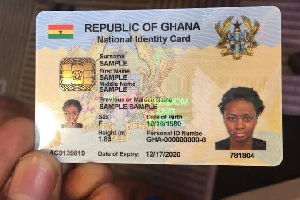
Ghana’s National Identification Authority has launched a nationwide enforcement exercise targeting banks, hospitals, telecommunications companies, and other institutions that continue to photocopy Ghana Cards or rely on visual inspection to verify identities, with businesses now facing fines of up to GH¢24,000 for non-compliance.
The crackdown, led by the NIA’s Biometric Verification Taskforce, began on Monday, November 2, 2026. It enforces the National Identity Register (Amendment) Regulations, 2026, known as L.I. 2523, which came into force on June 9, 2026. Under the new rules, institutions can no longer request, reproduce, scan, or retain photocopies of the Ghana Card for identity verification. They must instead use the NIA’s Identity Verification System Platform or an approved match-on-card biometric device to confirm a person’s identity.
The penalties are severe. Organisations that violate the regulations face fines ranging from 500 to 2,000 penalty units upon summary conviction. At the current value of GH¢12 per penalty unit, that translates to fines of between GH¢6,000 and GH¢24,000. Individuals who breach the law face fines ranging from 50 to 500 penalty units.
The government says the move is necessary to fight identity theft, document forgery, and the unauthorized use of personal information. Interior Minister Muntaka Mohammed-Mubarak argued that for too long, identity checks relied on officers glancing at a card or businesses photocopying it and filing it away. He noted that a photocopy can be altered and a scanned image can be misused without the cardholder’s knowledge.
But the timing and execution of the crackdown have drawn criticism. The regulation took effect in June, but the enforcement exercise only began in November, giving institutions less than five months to overhaul their systems and train staff. Many small businesses and under-resourced public institutions may struggle to afford the biometric verification devices or the platform integration required to comply. The fines are heavy enough to cripple a small enterprise, yet the government has not announced any support scheme or subsidy to help businesses make the transition.
Ordinary Ghanaians are also caught in the middle. Customers who are used to handing over their cards for photocopying at a bank or hospital will now be told to use a biometric system they may not understand or trust. The government has not launched a widespread public education campaign to explain how the new system works, what happens to their data, or what they should do if an institution refuses to serve them because its verification device is faulty.
The NIA has the power to enforce the law. It has the taskforce to do it. But it has not explained how it will ensure that the transition does not disrupt access to essential services, particularly for the poor, the elderly, and those in rural areas where digital infrastructure is weak. Instead of working with businesses to phase in the new system gradually, the government has opted for a sudden and punitive crackdown that puts the burden on the very institutions that serve the public.
This is a familiar pattern. The government introduces a regulation, sets a deadline, provides little support, and then punishes non-compliance. The biometric verification system may be a good idea in principle. But the way it is being implemented looks less like a public policy and more like a revenue drive. And Ghanaians will bear the cost.
About The Author







Leave a comment