



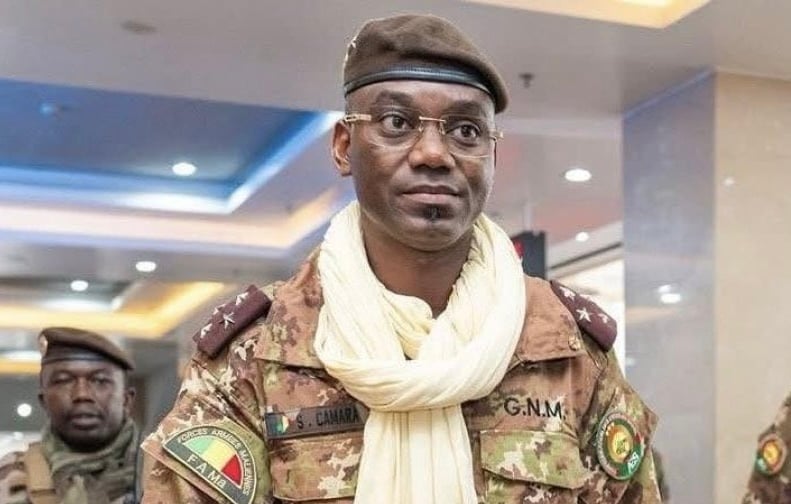
Mali’s military junta is facing its most severe challenge since seizing power in 2020, following a devastating nationwide offensive by an unprecedented alliance of Al Qaeda linked jihadists and Tuareg separatist rebels that has left the Defence Minister dead and a key northern city in rebel hands. The coordinated attacks, which began at dawn on Saturday, have plunged the fragile Sahel nation into a deep security crisis, with intense fighting reported in the capital and other major towns, raising fears that the country could be sliding back towards the chaos of 2012.
The most significant blow to the ruling administration came with the assassination of Defence Minister Sadio Camara. A car bomb struck his home in the heavily fortified junta stronghold of Kati, just outside the capital Bamako, killing the 47 year old general, his second wife, and two of his grandchildren. A close ally of junta leader General Assimi Goita and seen by some as a potential future leader, Camara was a central figure in the military government. The government issued a statement confirming his death, saying he died of his wounds in hospital after fighting his attackers.
Simultaneously, rebels from the Tuareg separatist coalition, the Azawad Liberation Front (FLA), and the Al Qaeda affiliated Group for the Support of Islam and Muslims (JNIM), launched assaults on multiple fronts. The FLA claimed it had reached an agreement allowing Russian Africa Corps forces, who have been backing the Malian army, to withdraw from the strategic northern city of Kidal, which they declared was “totally” under their control. The army had only recaptured the Tuareg stronghold in November 2023 with the help of Russia’s Wagner paramilitary group, making its loss a bitter symbolic defeat for the junta.
The offensive did not stop at the northern deserts. Heavy fighting was reported in the capital Bamako, including near the international airport, which was temporarily closed. The garrison town of Kati, the very heart of military power and home to junta leader Goita, was also a primary target. Explosions and sustained gunfire rocked the area as the army struggled to repel the attackers. As of Sunday, fighting was ongoing in several areas, including the northern towns of Kidal and Gao and the central city of Sevare. The whereabouts of General Goita himself remain unknown, although a security source told AFP he was in a safe place.
Analysts described the events as the largest coordinated jihadist attack in years, noting the remarkable tactical convergence between the separatist FLA and the jihadist JNIM. The two groups, which have historically been at odds, have united against a common enemy. “This looks like the biggest coordinated attack for years,” said Ulf Laessing, head of the Sahel program at the Konrad Adenauer Foundation in Germany. “And remarkably, there has been a coordination between jihadists and Tuareg rebels, which have nothing in common, but they have a joint enemy.”
The crisis represents a profound failure for the military government’s strategy. Since seizing power in a 2020 coup, the junta, led by Goita, severed long standing ties with former colonial power France and brought in Russian mercenaries to combat the growing insurgency. Instead of restoring security as promised, the situation has deteriorated, culminating in the most serious challenge to the country’s rulers since a 2012 offensive. The government has since imposed a curfew in the capital and attempted to reassure a terrified public, but residents remain on edge. “I still hear the blasts ringing in my ears. It’s traumatising,” one Bamako resident told AFP.
The violence has sent shockwaves through the region and drawn international condemnation. United Nations Secretary General Antonio Guterres condemned the “acts of violence” and called for coordinated international support to address the growing threat of violent extremism in the Sahel. The European Union also condemned the “terrorist attacks.” The offensive further destabilises an already volatile region where Mali’s junta, along with its allies in Burkina Faso and Niger, have recently broken away from the West African bloc ECOWAS to form their own Alliance of Sahel States, a move that has fractured regional security cooperation. For now, the streets of Kidal are once again in the hands of rebels, and the Malian state appears as fragile as ever.
About The Author



Leave a comment