






Yemen’s Houthi Hit US-Owned Cargo Ship with Ballistic Missile
 Confidence UbaniJanuary 16, 20242 Mins read1.2k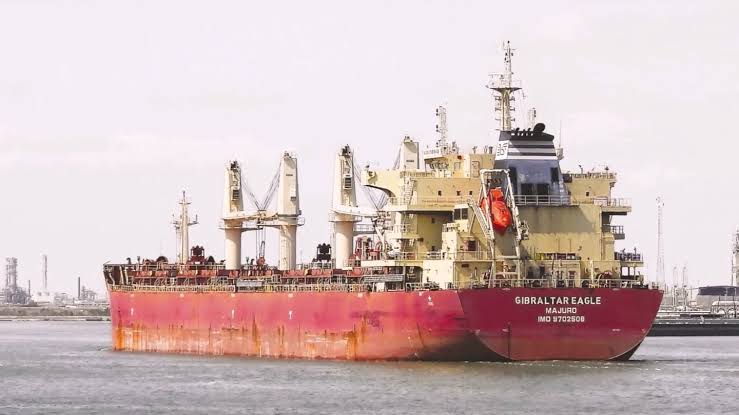
On Monday, off the coast of Yemen, the Houthis launched a missile attack on the US-owned cargo ship Gibraltar Eagle.
The United States Central Command confirmed the incident, stating that the ship sustained minor damage but continued its journey without any injuries reported. This attack marks the first successful strike by the Houthis on a US-owned vessel, occurring just days after a US-led coalition conducted.
The Gibraltar Eagle, carrying steel products, was hit approximately 100 miles offshore in the Gulf of Aden. At the heart of the attack was an anti-ship ballistic missile launched by the Houthis on Monday. Ambrey, a UK maritime security group, reported that three failed missiles were launched towards the Red Sea before the successful hit.
Eagle Bulk Shipping, the company operating the Gibraltar Eagle, confirmed that all crew members were unharmed and that the vessel remained seaworthy, suffering only limited damage.
Brig. Gen. Yehya Sare’e, the Houthis’ military spokesperson, claimed responsibility for the attack, stating that it was a direct response to US and UK aggression in Yemen. This re-echoes a previous statement by Houthis’ leader, Abdel-Malik al-Houthi, who said on Thursday that “any attack on Yemen’s Houthis on the part of the United States will not go without a response.”
The US and UK, along with allies, have in the past responded with targeted strikes on Houthi positions, aiming to neutralize their ability to threaten maritime security. According to BBC, experts argue that without addressing the broader conflict, including the situation in Gaza, such military responses might not be sufficient to deter further Houthi actions against commercial shipping.
Following the onset of the Gaza war, the Houthis have repeatedly targeted vessels with missiles and drones, disrupting trade and raising concerns about fuel prices and supply chains. Backed by Iran and controlling much of Yemen, they justify their actions as righteous support for Gaza.
Their aggression in the Red Sea has not only put them in the global spotlight but is forcing major shipping companies to reconsider routes through the Red Sea, a critical global waterway.
The economic implications of such attacks, if escalated, could be significant. The Red Sea is a vital waterway for global trade, especially for the transportation of oil and other commodities.
A sustained threat to shipping in this region could lead to higher shipping costs, longer delivery times, and increased prices for goods globally. Moreover, if key routes like the Bab el-Mandeb Strait are impacted, it could disrupt a significant portion of global maritime traffic, putting further strain on international trade and economies still recovering from recent global challenges.
The rising tensions, no doubt, put the stability of one of the world’s most crucial waterways at stake.
About The Author



Related Articles

Gambia’s FGM Ban Under Threat as Imam Abdoulie Fatty and MP Almameh Gibba Push to Make Cutting Girls Legal Again
Two men are leading the charge to overturn The Gambia’s ban on...

Peter Obi Rejects $123m Anambra Debt Claim, Says He Left Over $150m in Funds
Peter Obi has rejected claims that he left Anambra State with $123...

Senegal Signs $3.5bn Refinery Deal With Turkey’s Yamata to Process Local Crude, Target West African Fuel Market
Senegal’s state refiner, the Société Africaine de Raffinage (SAR), has signed a...


Tinubu Awards $7bn Ogun Deep Seaport Deal to Chagoury-Linked DP World as Nigerians Question His Priorities
President Bola Tinubu’s administration has awarded two major Ogun State deep seaport...