





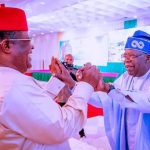
Another N2.5 Trillion Road Project, Another Opportunity for Tinubu and Umahi to Waste Nigerians’ Money
 West Africa WeeklyAugust 5, 20264 Mins read352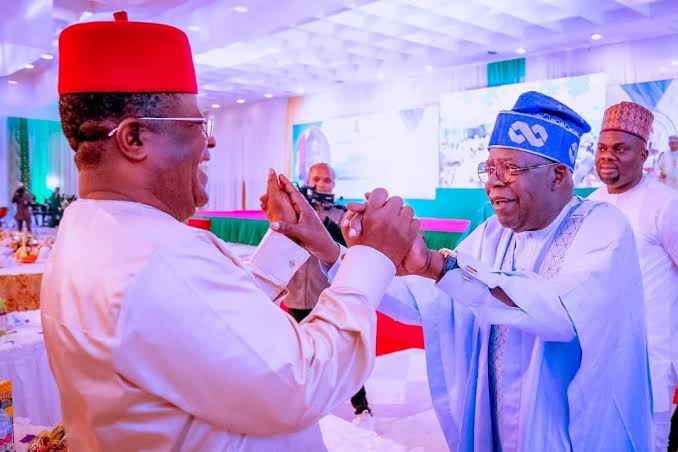
The Federal Government has earmarked N2.47 trillion in the 2026 budget for the rehabilitation and reconstruction of 124 roads considered critical to Nigeria’s economic activities. The projects include the Lokoja-Abuja Road at N12.6 billion, the Enugu-Port Harcourt Road at N19.6 billion, the Kano-Katsina Road at N23.6 billion, and the Aba-Owerri-Ikot Ekpene Road at N7.7 billion. The government says these roads will boost trade, reduce logistics costs, and stimulate economic growth. But Nigerians have heard this before. They have watched billions disappear into roads that collapse within months, contracts awarded to unqualified contractors, and funds diverted to private pockets. And they are watching again as President Bola Tinubu and his Minister of Works, David Umahi, prepare to squander another N2.5 trillion.
The numbers alone should make every Nigerian suspicious. The government is spending N12.6 billion on the Lokoja-Abuja Road, N19.6 billion on the Enugu-Port Harcourt Road, and N23.6 billion on the Kano-Katsina Road. But these figures mean nothing without context. The Lagos-Calabar Coastal Highway, one of Tinubu’s signature projects, is estimated to cost over N15 trillion upon completion. Minister Umahi has admitted that the coastal highway is costing Nigerian taxpayers an average of N7.5 billion per kilometre. Former Vice President Atiku Abubakar has repeatedly warned that the cost is inflated, and he has been vindicated by Umahi’s own admission that the actual cost is closer to N8 billion per kilometre. Atiku has called for an independent value-for-money audit of the project. The Human Rights Writers Association of Nigeria has also demanded a forensic audit. But Tinubu and Umahi have refused. They have refused to publish the contractual details. They have refused to explain why a road that should cost N238 million per kilometre is now costing N8 billion.
The pattern of waste is unmistakable. Since Tinubu assumed office in May 2023, the Federal Government has approved a staggering N929.06 billion on contract variations and additions to inherited road and bridge projects. In June 2026 alone, the Federal Executive Council approved over N2 trillion for road projects across 10 states. In July 2026, the council approved 27 federal road projects worth more than N3.9 trillion across 15 states. The government is spending money it does not have on projects it cannot manage.
The track record of the Ministry of Works under Umahi offers little reason for optimism. The minister has terminated contracts, withdrawn projects from contractors, and accused firms of abandoning sites. In November 2024, Umahi expressed shock over the lack of visible progress by the contractor handling the Abuja-Minna road project. In June 2025, he terminated the Benin-Warri road contract over the contractor’s failure to deliver. In October 2025, he withdrew the Abuja-Keffi road project from a Chinese firm. The minister has also admitted that some roads had remained unbuilt for up to 50 years. But rather than fixing the system, Umahi has continued to award new contracts while old ones remain abandoned. The government has vowed to weed out non-performing contractors, but the problem is not just the contractors. It is the system that awards contracts without proper oversight, inflates costs without accountability, and allows billions to disappear without consequence.
READ MORE: Cameroon’s Biya, Unseen for 58 Days, Reshuffles Military Leadership Amid Succession Fears
The contradictions in Umahi’s own statements are telling. In June 2026, the minister acknowledged funding constraints and reduced the scope of the Abuja-Lokoja road from 49.28 kilometres to 28 kilometres to concentrate resources on critical portions. But the government is still spending N12.6 billion on the Lokoja-Abuja Road. How can the government justify spending billions on new projects when it cannot even complete the ones it has already started? The Deputy Senate President has called for the revocation of the Kano-Gwarzo-Dayi road contract over the contractor’s alleged poor performance. The Senate is raising concerns, but the Ministry of Works continues to award contracts as if nothing is wrong.
The economic cost of this failure is devastating. Nigeria has the highest number of people living in poverty on the continent, with 61 per cent of the population living below the poverty line and 33 per cent classified as ultra-poor and unable to meet their minimum food requirements. Food inflation has peaked at 40.9 per cent. The naira has lost more than 70 per cent of its value against the dollar. Yet the government continues to spend trillions on roads that may never be completed, while millions of Nigerians cannot afford three meals a day.
The N2.5 trillion allocated for these roads is not just a number. It is money that could have built schools, equipped hospitals, provided water, or fed the hungry. It is money that could have been spent on security to protect farmers from bandits. It is money that could have been used to address the hunger crisis that has pushed 34.7 million Nigerians into food insecurity. Instead, it is being thrown at roads that will either be abandoned, overpriced, or poorly constructed.
The question Nigerians must ask is simple: why should we trust this government with another N2.5 trillion when it has already wasted N929 billion on contract variations? Why should we believe that these roads will be different from the Lagos-Calabar Coastal Highway, which is now costing N8 billion per kilometre? Why should we accept that the Ministry of Works, which has terminated contracts, withdrawn projects, and admitted to decades of neglect, can suddenly deliver value for money?
The answer is that we should not. Tinubu and Umahi have shown us who they are. They are politicians who treat infrastructure as a cash cow, not a public good. They are leaders who promise roads but deliver potholes. They are administrators who award contracts to cronies while Nigerians suffer. And they are counting on Nigerians to keep looking the other way. But Nigerians are watching. They are counting. And they will remember.
About The Author

Related Articles
Gambian Businesses Struggle Under Prolonged Blackouts as Anger Mounts Ahead of December Election
Gambian businesses are collapsing under the weight of prolonged power cuts that...
Chelle Names Osimhen, Lookman, Ndidi in 24-Man Super Eagles Squad for 2027 AFCON Qualifiers
Super Eagles head coach Éric Chelle has unveiled a 24-man squad for...
Ghana Cuts Fuel Exports to Burkina Faso and Mali to Protect Its Own Supply
Ghana’s state-owned fuel distributor BOST Energies has reduced diesel and gasoline exports...

ASUU Strike Threatens to Shut Down Federal Universities as Nigerians Accuse Media of Ignoring the Crisis
The Academic Staff Union of Universities is on the verge of a...
Leave a comment