






After Taiwo Oyedele’s Denials, Lagos State Activates ‘Power of Substitution’ Under Tinubu-Altered Tax Law, Allowing Authorities to Redirect Payments Without Court Orders
 West Africa WeeklyJanuary 26, 20263 Mins read879
Lagos State has moved to activate a controversial enforcement provision in the nation’s revamped tax law, giving its revenue service the authority to recover unpaid taxes from third parties without first securing a court order. The decision follows weeks of public assurances from presidential adviser Taiwo Oyedele that banks could not arbitrarily deduct money from Nigerians’ accounts under the new tax regime.
In a public notice, the Lagos State Internal Revenue Service said it will begin using what is known in the Nigeria Tax Administration Act of 2025 as the Power of Substitution. The provision allows tax authorities to go beyond the defaulting taxpayer and direct third parties, including banks, employers, tenants, debtors and other entities holding or owing funds to those taxpayers, to remit sums owed to the state. Once served with a substitution notice, the receiving party is legally obliged to make the payment on behalf of the taxpayer.
The move has crystallised a widening gap between the government’s communication on the tax overhaul and how the new rules are being applied on the ground. Taiwo Oyedele, a senior economic adviser to President Bola Tinubu, repeatedly told Nigerians that banks could not withdraw funds from their accounts to pay taxes under the reformed system. His statement was widely circulated on social media and helped calm fears among households and businesses that feared sudden debits or frozen accounts.
The Lagos LIRS notice, however, makes clear that the Power of Substitution can be invoked to recover unpaid tax liabilities without recourse to court proceedings. The law states that once a tax liability has been established through an assessment and remains unpaid, the tax authority may serve a substitution notice on any person or institution that holds funds belonging to the taxpayer or owes money to the taxpayer. Upon receipt, that person or institution must remit the specified amount directly to the tax authority.
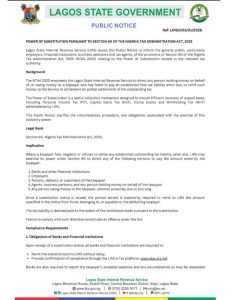
In practical terms, this gives revenue officials a method to collect debts by stepping into the shoes of the taxpayer’s creditors or account holders. For example, a bank with funds belonging to a defaulting taxpayer could be instructed to pay part of those funds to the Lagos tax authority. Similarly, a landlord collecting rent on behalf of a tax defaulter might be required to redirect that money to settle outstanding liabilities.
The implementation of this provision comes amid broader concerns about the clarity and communication of Nigeria’s tax reforms. The 2025 overhaul of the nation’s tax laws was presented as a modernisation effort designed to widen the tax base, improve revenue collection and reduce reliance on oil earnings. Multiple pieces of legislation were passed to harmonise outdated statutes and to empower revenue agencies with new enforcement tools.
READ MORE: Ivory Coast to Buy Unsold Cocoa to Support Farmers
Despite official statements insisting that no new taxes have been introduced, the practical effect of some provisions has left many Nigerians confused. The Lagos LIRS action in particular has raised questions about how far enforcement powers extend and what protections, if any, taxpayers have against aggressive collection measures.
For ordinary residents and businesses in Lagos, the announcement is significant. While substitution powers are not new in global tax practice, their activation without a broad public explanation intensifies anxieties about financial autonomy and the risk of funds being redirected without prior notice. This is particularly sensitive in an economy where many households live close to the margin and have limited cash buffers.
Supporters of the tax reform say that measures like the Power of Substitution were meant to close longstanding compliance gaps and ensure that those who owe taxes contribute their fair share. Tax authorities argue that traditional recovery methods, such as lengthy court proceedings and administrative appeals, have been insufficient to address widespread evasion and delayed payments.
Critics, however, point to a disconnect between government messaging and statutory enforcement. When senior officials reassure the public that banks cannot touch personal accounts for tax purposes, only for a state revenue service to invoke a mechanism that effectively allows just that under specified conditions, confidence in the system erodes.
The Lagos State notice did not provide detailed guidance on how substitution notices will be applied or the safeguards available to taxpayers who believe they have been wrongly assessed. The absence of clear communication on procedural protections has added to public unease.
As the Power of Substitution becomes more visible, the broader debate over transparency, enforcement, and taxpayer rights in Nigeria’s new tax environment is likely to deepen. For now, Lagos has signalled that it will make use of statutory powers to collect revenue. Whether the rest of the country follows suit and how taxpayers respond remain to be seen.
About The Author



Related Articles

Algeria Severs Diplomatic Ties With UAE, Closes Airspace to Emirati Aircraft
Algeria announced on Thursday that it was cutting diplomatic ties with the...
Gambia Bans Protests Without Permits After Blackout Unrest Erupts Ahead of December Election
Gambia’s police chief has banned all public protests without official permits after...


Sanwo-Olu Blames Cranes and ‘Iconic Cane’ as Ojota-Opebi Bridge Misses Another Deadline
Lagos State Governor Babajide Sanwo-Olu has offered yet another explanation for why...
Gambia Protests Turn Chaotic as Power Outages Worsen Ahead of December Elections
Thousands of Gambians took to the streets overnight in Banjul and surrounding...
Leave a comment