






Nigeria’s Trade Recovery Lags Behind Despite AfCFTA Implementation
 Ikenna ChurchillMarch 12, 20241 Mins read1.1k
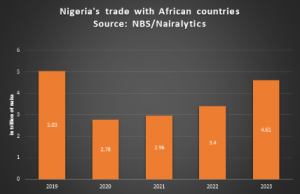
Nigeria’s trade with African countries has struggled to regain momentum following the COVID-19 pandemic despite the enactment of the African Continental Free Trade Area (AfCFTA) agreement in 2021. According to the latest data from the National Bureau of Statistics (NBS), there’s a gradual uptick, but trade volumes have yet to reach the heights seen before the pandemic, raising questions about the effectiveness of AfCFTA in stimulating a robust trade revival.
Trade Trends:
In 2019, Nigeria’s trade with other African nations peaked at N5.03 trillion, with imports at N1.11 trillion and exports at N3.92 trillion. However, the onset of the pandemic in 2020 caused a sharp decline, with imports plummeting to N406.88 billion and exports to N2.37 trillion, totalling N2.78 trillion in trade. Subsequent years saw a slow recovery, with imports and exports gradually increasing but still falling short of pre-pandemic levels.
ECOWAS Dominance:
Analysis reveals that Nigeria’s trade with the Economic Community of West African States (ECOWAS) countries accounts for 52% of its trade with African nations in 2023. While there’s progress in nearing pre-COVID-19 export levels to ECOWAS countries, imports have yet to catch up, indicating lingering challenges.
Challenges and Insights:
Several challenges hinder Nigeria’s trade recovery, including power supply issues, insecurity, inadequate infrastructure, foreign exchange shortages, and currency depreciation. Despite the potential of AfCFTA to boost intra-African trade, its full implementation faces obstacles such as lack of awareness, political will, and security concerns.
The potential of AfCFTA:
Experts believe that AfCFTA, when fully implemented, could significantly enhance intra-African trade, lift millions out of poverty, and boost the continent’s GDP. However, challenges remain in finalizing agreements and addressing trade facilitation mechanisms to unlock AfCFTA’s full potential.
Nigeria’s trade recovery post-COVID-19 has been gradual, with AfCFTA yet to deliver the anticipated surge in intra-African trade. This underscores the need for deeper introspection, policy reforms, and infrastructure development to fully leverage the benefits of AfCFTA and propel Nigeria’s trade figures beyond pre-pandemic levels.
Read: Interswitch Ventures into Nigeria’s Telecom Sector with MVNO License
About The Author



Related Articles

Traore Launches $30 Million Textile Complex to Cut Burkina Faso’s Reliance on Clothing Imports
Burkina Faso’s military leader, Captain Ibrahim Traore, has inaugurated a $30 million...
Senegal to Reprofile Debt Rather Than Restructure, Prime Minister Says
Senegal’s Prime Minister Ahmadou Al Aminou Lo has told parliament that the...
BudgIT Exposes N6.93 Trillion in Questionable Projects Inserted Into Nigeria’s 2026 Budget
A comprehensive analysis by BudgIT, a civic technology organisation promoting transparency in...

Senegal Starts Countdown to First African Default Since 2023 as $5 Billion Bond Restructuring Looms
Senegal has begun the countdown to what could become Africa’s first sovereign...