






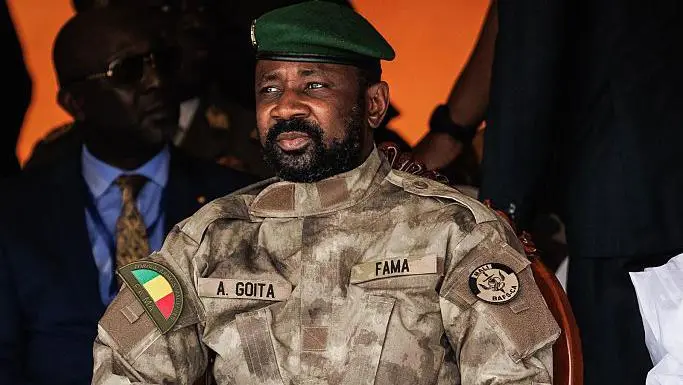
Mali’s military has placed a massive bounty on the head of Iyad Ag Ghaly, the leader of a notorious jihadist group, in a dramatic escalation of its fight against insurgents. The government is offering 2 billion CFA Francs, equivalent to about $3.5 million, for information leading to the capture or killing of the man who leads the al-Qaeda affiliate Group for the Support of Islam and Muslims, widely known as JNIM.
The announcement on state television named six other rebel leaders on the same wanted list, including one of Ghaly’s deputies and two officials from the Azawad Liberation Front (FLA), a Tuareg separatist group. The government said the individuals were wanted for their involvement in planning, organising, and executing acts of terrorism that threaten the safety of people and their property within Mali’s borders.
The move comes barely a month after devastating coordinated attacks in April by a rare alliance between the JNIM jihadists and Tuareg separatists, which killed Defence Minister Sadio Camara. During that assault, the rebel coalition captured key strategic territories from the Malian army, including the northern town of Kidal.
Iyad Ag Ghaly, the prime target of the new bounty, is a veteran figure in the Sahel’s conflicts. A former Malian diplomat from the Tuareg ethnic group, he led a separatist rebellion against the government in 2012. The International Criminal Court has an arrest warrant for him on charges of war crimes and crimes against humanity committed between 2012 and 2013, a warrant that was initially sealed but made public in 2024.
Ghaly was also a key negotiator for the release of hostages kidnapped by al-Qaeda, securing the freedom of 14 mostly German tourists in 2003. He is also on the United States terrorist list and is under United Nations sanctions.
READ MORE: Concerns Rise Over Anonymous Alert of Planned Terrorist Attack on University of Nigeria, Nsukka
The bounty is just one part of a broader security crackdown by the ruling junta, which has failed to significantly improve security despite support from Russian mercenaries. In a related measure, the government has banned the sale and use of large motorcycles, with engines of 125 cubic centimetres and higher, outside major urban areas. This is designed to curb the mobility of militant groups, which frequently use motorcycles for swift hit-and-run attacks.
In further military action, the Malian army has carried out successful strikes against armed terrorist groups. A major terrorist hideout was targeted in the Sandaré area, where around thirty terrorists and several motorcycles were destroyed. Another strike targeted a hideout of about twenty terrorists in Doro, near Gao, where several motorcycles were also identified.
Mali has also intensified the fight against terrorism by creating military zones in around 40 forests, aiming to prevent the area from being used as sanctuaries or transit corridors by insurgents.
As Mali continues to face an escalating security crisis, analysts remain divided on whether financial incentives will have any significant impact on the country’s broader security situation. The government is urging the public to cooperate as it moves to tackle the growing insurgency.
About The Author




Leave a comment